Please Press the Program Mode Button on Your Teensy to Upload Your Sketch.
Troubleshooting Common Issues
If your question isn't answered here, please mail service on the forum. PJRC does monitor the forum and every attempt is made to respond client questions.You must mail service lawmaking or details needed to reproduce the trouble. Please read the posting guidelines. Just a few minutes to compose a detailed question usually results in much better assistance.
The Teensy Quick Reference: Code Examples, Tips and Tricks list has a list useful resource and solutions for many mutual projects.
The Near Common Problems
#1: LED Blinks Merely No USB Communication: Many cell phones are sold with charging-but cables. They take but ii wires for power, but are missing the ii data wires. Try another USB cable, ideally ane known to work for USB.#two: No COM Port or Serial Device Seen: Teensy uses HID protocol for uploading, not series. Make new Teensy boards are shipped with the LED glimmer example compiled to announced as RawHID. Yous must program Teensy at least once from Arduino. The COM port (Windows) or Series Device (Mac, Linux) appears only later on Teensy begins running your program. Regular Arduino boards are always serial. Teensy uses HID and supports many protocols. To use serial, make sure the Tools > USB Type carte is set to "Serial", and understand Teensy only becomes a serial device when it runs your program built with this setting.
#3: Dead (commonly overheating) Main Chip: More than iv volts applied to the 3.3V power pin instantly kills a Teensy LC or 3.2. Be extremely careful if connecting circuits to Teensy using both VIN(5V) & 3.3V pins, or when using any external ability supply. Loose wires between Teensy and other electonics accidentally touching are the nearly common way Teensy fails. Just a few extra minutes to cover exposed leads and mechanically secure loose wires, especially if they can easily unplug from a solderless breadboard, tin save y'all from an unpleasant and costly "learning experience".
Unreliable Communication
Some USB hubs have trouble handling the rapid sequence of connect/disconnect events when programming Teensy. Most hubs work fine, but the few that do not can cause very strange problems. If y'all experience trouble, e'er try connecting Teensy directly with a quality USB cable.Teensy 3.0 Not Recognized by Teensy Loader
Teensy Loader ane.07 is the offset version to support Teensy iii.0. Y'all can check the version using Help > Virtually. Version 1.07 is role of the Teensyduino installer. It automatically runs when you click Upload or Verify in Arduino.Make New Teensy Not Recognized
When a brand new Teensy has never been recognized by Teensy Loader, follow these steps.- Starting time, reboot your computer and remove any other circuitry connected to the Teensy.
- The LED should blink when the USB cable is plugged in. Every Teensy is pre-programmed with a LED glimmer program during production testing. No drivers or software on your computer are needed for the LED blink. Only power from the USB cable is necessary. If the LED does not blink, check the voltage on the board using a voltmeter, or try some other cable or USB port, and avoid any USB hubs. If the LED never blinks, exercise not worry well-nigh drivers or software. No LED blink indicates the board is non receiving ability!
- When the pushbutton is pressed, the LED should stop blinking. No software or drivers on your computer are necessary for the button to finish the LED blink. When the LED blinks and the pushbutton causes the blinking to stop, this is a very good indication your Teensy hardware is performance properly.
- When the LED stops blinking, if the Teensy Loader program is running, it should detect the Teensy lath. The "Press Push button To Activate" message volition disappear and the image will show which board is present. No drivers need to exist installed on Windows or Mac for this to work. On Linux, the udev dominion file must be installed. If the LED blinks, and the pushbutton stops the blinking, only Teensy Loader never detects your board, and you've followed the steps above, the trouble is almost certainly a faulty USB cable. Many USB cables made for charging devices have but power wires merely no data lines.
- On Windows, the driver installation is simply necessary for using the Arduino Serial Monitor when Teensy implements a Serial device (from the Tools > USB Type menu), and to automatically reprogram using "Upload" when Teensy has been programmed as Serial. Without the driver, 5 seconds after y'all click Upload, a message will appear asking you to printing the pushbutton on your Teensy. Windows may give you misleading errors indicating drivers must exist installed, but NO DRIVER IS NECESSARY on Windows to simply get Teensy Loader to recognize your Teensy and program new code. Follow steps one-iii to a higher place before worrying about drivers!
Teensy Non Recognized by Teensy Loader
A previously working board may seem to be dead, but the problem may simply be code on your Teensy which confuses your PC's USB port.- Physically disconnect the Teensy.
- Reboot your computer (complete power off is all-time)
- Make sure the Teensy Loader application is running.
- Concord the reset button down, before plugging in the USB cable.
- Plug the USB cable in while continuing to hold the button.
- After the cable is fully inserted, release the button.
On Windows systems, "strange" problems are occasionally reported, where Windows will not discover new devices. Information technology does not seem to exist unique to Teensy. Creating a new user account sometimes solves the problem. Plugging the cablevision into different USB ports can likewise aid. Rebooting is always a good idea. The all-time approach is to endeavor on a Mac or Linux motorcar, or a unlike Windows machine.
No Serial Port While Programming
This is normal. Teensy is Non natively a serial device.Arduino boards appear equally a series device for all programming and communication. Arduino remains continued equally a serial device while it reboots. Teensy is a native USB device. Experience troubleshooting Arduino does not use to Teensy!
During programming, Teensy appears as a HID device. When Teensy reboots, electrically your computer sees Teensy disconnect, equally if the cable were physically unplugged. When Teensy begins running your program, the USB is disconnected.
The fast and tedious LED glimmer examples practice not enable the USB port.
When programs do employ USB, type of device Teensy becomes depends on the lawmaking you have loaded. Your computer will see a new USB device connect when your program begin using the USB port. In Arduino, the device type is controlled by the Tools > USB Type carte. In C language, the USB code you use determine the type of device. The hid_listen program only responds to specific C programs. While troubleshooting, you must look for the type of device which your program implements.
TODO: list of C lawmaking and Teensyduino device types, VID/PID numbers for each.
Pushbutton Does Not Reset Application
The pushbutton lets y'all to manually put Teensy into programming style. With Arduino, this happens automatically when you click Upload. But if your code disables the USB port, or disables interrupts, or enters a deep sleep mode which terminate the CPU, Teensy tin non respond to the USB-based reboot request.Every Teensy is made with a concrete pushbutton to allow recovery from a non-responding programme.
The pushbutton does Not reset Teensy to restart your application. However, if Teensy is connected to your computer, and Teensy Loader is running and configured for automatic manner (the default when used with Arduino), pressing the button volition enter programming mode. Teensy Loader volition quickly reprogram and restart your Teensy. This restart of your application is due to Teensy Loader's "auto" mode, not simply the pushbutton.
LED Blinks Green or Blue
You take a apocryphal board. PJRC has never made whatsoever Teensy with a dark-green or blue LED. If you purchased using Ebay and Paypal, we recommend y'all immediately begin a dispute on Paypal's website. Do not carp contacting the seller. They have already scammed many other people with defective boards, just they just do not care. A dispute on Paypal is the only way you will recover your money. The sooner you lot file the dispute, the meliorate your odds of receiving a refund. We recommend waiting to go out negative feedback until after Paypal returns your money.Large Programs Mysteriously Crash
On Teensy ii.0, the compiler places string constants in RAM. If y'all accept accept many, RAM can run out quickly. In Arduino, you can use F() to cause strings used with impress() to avoid using RAM.void loop () { Keyboard .print(F("This is long string does non use RAM, due to F()"); Serial .println(F("Another string"));filibuster(250); }
In C language, usually PSTR() is used, and special functions which access wink memory must be called. Frequently they have a "_P" suffix.
Large data tables or arrays can likewise crusade trouble. If information is constant, PROGMEM and pgm_read_byte() can be used. Run across the avr-libc transmission for details.
Teensy LC, 3.0, iii.ane practice not have this problem. Variables defined with "const" are placed simply in flash retentivity, simply can be accessed normally. Just the older 8 bit AVR-based boards require these special steps to foreclose strings and read-merely variables from consuming limited RAM.
Windows: Serial Driver Installed But Not Used
On Windows, even if the series driver installer has run correctly, sometimes Windows will retain old information in its registry and neglect to load the driver. The Device Manager will evidence "USB Serial" with an error, instead of "USB Serial (Communication Class, Abstract Command Model)" with a COM port number assigned.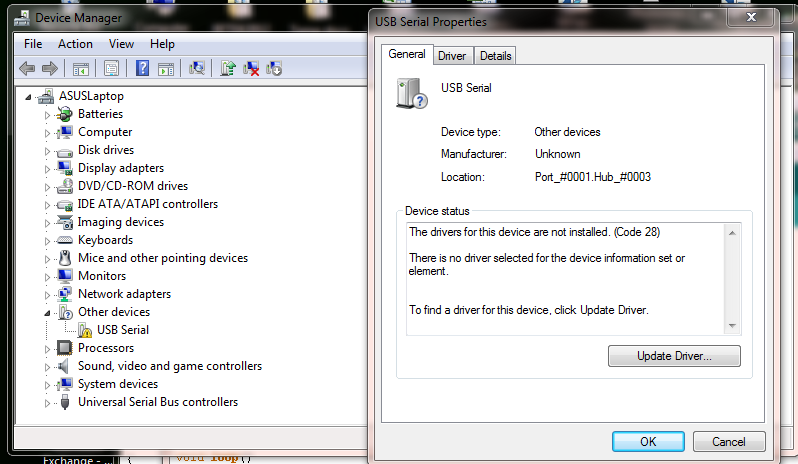
These actions normally tin can cause Windows to re-observe the device and begin using the correct driver.
- Run the serial installer plan again, or run the Teensyduino installer and utilize the update driver choice on the beginning stride.
- Click that "Update Driver" button in the device manager. If the commuter installer has run, Windows should be able to detect the commuter.
- Plug the cable into a unlike USB port. The Windows Registry handles each concrete port with separate registry entries.
- Do and/all of the in a higher place with or without the device connected. Sometimes Windows volition practice things differently if the device is nowadays or absent.
If there is no "USB Serial" at all, please rememober Teensy only becomes a Serial device when programmed to do so. See "No Serial Port While Programming" above.
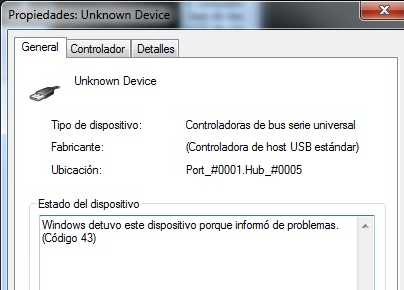
Windows seven: Unknown Device (Code 43)
Windows "Lawmaking 43" is a mystery. Other devices, even Apple iPod, take experienced this trouble. The solution seem to be be completely powering down, and if a latop, remove the battery for a few minutes. This same solution has been reported multiple times with success.This code 43 error is a mystery. It might be related to laptops entering suspend mode? If you have whatever insight, please contact u.s.!
Pieter Rautenbach plant a case where programming the wrong HEX file (compiled for a different bit) causes error 43.
Windows: Teensy Loader Window Does Not Appear
On Windows, if multiple monitors are used and then only a single monitor is later used (eg, a laptop used at a docking station), the Teensy Loader may attempt to appear on the missing monitor. The Teensy Loader appears in the Windows Task Bar, but not on the screen.- Windows 7: Concur the shift fundamental and right click on the Teensy Loader in the Task Bar.
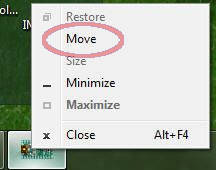
Windows Vista & XP: Right click on the Teensy Loader in the Task Bar. - Select "Move".
- Employ your keyboard pointer keys to move the window until it appears.
Boosted info from Gilbert Hersschens:
"Since you can't see the missing window, you won't know for certain if information technology'south visible or subconscious. But you can meet this in the context menu. When the window is shown on the missing display, the menu item "Motility" will be agile and the particular "Restore" will be greyed out. When information technology'south hidden, it will be just the opposite. Y'all tin can merely motility a window in its visible country. To hibernate or unhide a window, you lot can click on the icon in the taskbar to toggle its state or use the corresponding menu items in the context menu.
Linux: Gentoo & Curvation AVR Toolchain
The AVR toolchains provided by Gentoo and Curvation are cleaved. They compile .hex files which simply do non work! Starting with version 1.0.ane, Arduino downloading from world wide web.arduino.cc has a known-practiced toolchain.If running avr-gcc with a makefile, download Arduino i.0.1 and gear up your $PATH to access the toolchain in arduino-1.0.one/hardware/tools/avr/bin directory.
Linux: Long Delay Earlier USB Serial Detected
On some Linux systems, USB Serial is detected very slowly. The kernel detects the device quickly (ordinarily seen with "tail -f /var/log/messages"), but the device files exercise not appear for a very long time.Edit "/lib/udev/rules.d/77-nm-probe-modem-capabilities.rules", adding this line:
SUBSYSTEMS=="usb", ATTRS{idVendor}=="16c0", ATTRS{idProduct}=="04[seven-9]?", GOTO="nm_modem_probe_end" Linux: Many Duplicate Device Names with Ubuntu 9.10
On Ubuntu 9.10 (and possibly other systems), when using a serial device type, the kernel assigns a new number each time, /dev/ttyACM0, /dev/ttyACM1, /dev/ttyACM2, etc.This is acquired by the Gnome Modem Manager, which holds the port in (every bit far every bit the kerel is concerned) utilize even afterward you have reset the Teensy and the port no longer exists. The simplest solution is to uninstall Modem Manager, and restart the network manager or simply reboot.
apt-become remove --purge modemmanager
You could also try deleting /usr/lib/ModemManager/libmm-plugin-generic.so and of course reboot. This might go out Modem Director able to work with well-nigh modems, but not interfere with Teensy.
Modem Manager'southward troublesome probing and inability to configure exclusions for specific device is a known bug. Hopefully it volition exist fixed in future releases.
Windows: Teensyuino Installer Unable To Write
Delight temporarily disable whatever anti-virus software. Many "heuristic" anti-virus programs do not like one program writting to some other. The Teensyduino installer needs to alter many files inside the Arduino software. "Windows Essential Security" has been reported to cause problem.Source: https://www.pjrc.com/teensy/troubleshoot.html
0 Response to "Please Press the Program Mode Button on Your Teensy to Upload Your Sketch."
Post a Comment